Historic Akaroa
Akaroa: New Zealand’s Best-Preserved Historic Town
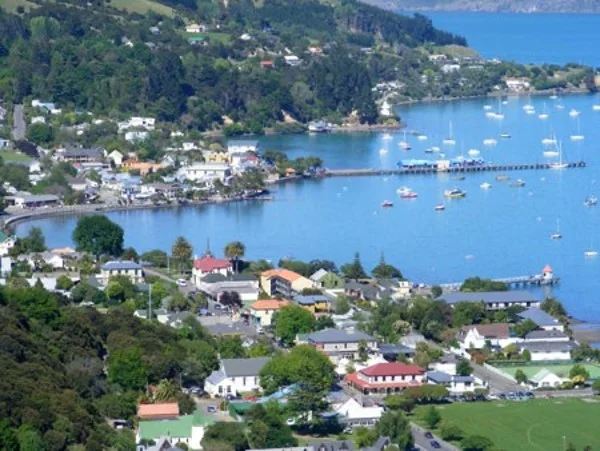
Akaroa is one of New Zealand’s best preserved and most beautifully situated historic towns. The sheltered bay on which it sits opens onto a magnificent harbour that is the eroded and flooded crater of an ancient volcano. The harbour is ringed by rugged high hills. The town’s superb setting is what first impresses visitors to Akaroa. The town’s setting is matched by its historic and architectural interest.
This website celebrates the historic character and charm of Akaroa. The Akaroa Civic Trust is one of the most active and effective guardians of the town’s historic character and charm. It also works hard to increase awareness of the town’s important place in New Zealand’s historical and architectural development.
The Civic Trust was founded by local residents in 1969 to preserve Akaroa’s history and character. Its members work with the Christchurch City Council on District Plan matters which affect the development of the town. The Trust supports new developments which are in harmony with the town’s historic character and encourages appropriate adaptive new uses for the town’s historic buildings.
Enjoy, Prosper and Protect
Akaroa is a special place, let’s keep it that way.
It’s our shared responsibility
The economy of Akaroa has benefited from visitors attracted by the historic charm of our small town in a dramatic natural setting. The Akaroa Civic Trust and the Akaroa Residents and Ratepayers Association believe that it is possible to have strong and dynamic tourism which does not harm the natural environment and maintains the town’s delightful appeal.
Akaroa needs to attract domestic and international visitors who stay and spend time in the town and surrounding area. In order to achieve this balance cruise ships visits must be carefully controlled and the activities of freedom campers must be properly monitored.
If you would like to learn more about our proposal click here.
Help Us Build a Viable and Sustainable Environment for Future Generations
For further information please contact us.
Historic Akaroa
A Story of Settlement, Culture & Character
From the first Polynesian voyagers to the French settlers of 1840, from colonial growth to 21st-century heritage protection — this is Akaroa’s story.
Māori: Tangata Whenua
The Māori phrase tangata whenua means “the people of the land.” Māori settlers, coming from eastern Polynesia, arrived on Banks Peninsula probably 700 or 800 years ago. They encountered a peninsula clothed in forest rich in bird life, with abundant food resources from the surrounding sea. Banks Peninsula was at about the southern limit for growing kūmara, the sweet potato which was the staple of Māori agriculture.
One of the peninsula’s older names — Te Pataka o Rakaihautu, the food storehouse of Rakaihautu — reflects this abundance. Rakaihautu was one of the earliest explorers of the South Island; the range of hills on the far side of Akaroa Harbour is said to be the ko (digging stick) with which he scooped out the great southern lakes. The peninsula was also known as Horomaka.
The tribe occupying most of the South Island when the first Europeans arrived was Ngāi Tahu, who had moved south from the North Island in the 18th century. Several hapū (family groups) occupied different parts of the peninsula. The sites of many Ngāi Tahu settlements still bear traditional names. The Treaty of Waitangi was signed at Onuku in 1840 by two Ngāi Tahu chiefs, and there has been a continuous Māori presence at Onuku ever since.
The Early Europeans
The Māori phrase tangata whenua means “the people of the land.” Māori settlers, coming from eastern Polynesia, arrived on Banks Peninsula probably 700 or 800 years ago. They encountered a peninsula clothed in forest rich in bird life, with abundant food resources from the surrounding sea. Banks Peninsula was at about the southern limit for growing kūmara, the sweet potato which was the staple of Māori agriculture.
The first Europeans known to have sighted Banks Peninsula were James Cook and his companions on the Endeavour, who in February 1770 saw the high hills of the peninsula from some distance offshore. Mistaking it for an island, Cook named it Banks Island, after the naturalist Joseph Banks. It was not until 1809 that Captain Chase established it was in fact a peninsula.
By the 1820s and 1830s, whalers from several nations were anchoring in Peninsula bays. The shore whaling station George Hempelmann established at Peraki in 1837 was the first permanent European settlement in Canterbury. In 1830, a British trader’s complicity in a devastating attack on Ngāi Tahu at Takapuneke — just south of where Akaroa would later be founded — became a key incident in the British decision to assert sovereignty over New Zealand, leading to the Treaty of Waitangi.
The tribe occupying most of the South Island when the first Europeans arrived was Ngāi Tahu, who had moved south from the North Island in the 18th century. Several hapū (family groups) occupied different parts of the peninsula. The sites of many Ngāi Tahu settlements still bear traditional names. The Treaty of Waitangi was signed at Onuku in 1840 by two Ngāi Tahu chiefs, and there has been a continuous Māori presence at Onuku ever since.
The French Settlement
Your content goes here. Edit or remove this text inline or in the module Content settings. You can also style every aspect of this content in the module Design settings and even apply custom CSS to this text in the module Advanced settings.
Among the whalers who put into Akaroa Harbour in the late 1830s was a French captain, Jean François Langlois. He returned to France believing he had purchased all of Banks Peninsula. The Nanto-Bordelaise Company, with tacit French Government support, sent the Comte de Paris with nearly 60 settlers to establish a French colony in 1840.
By the time the settlers arrived in August 1840, New Zealand was already British — the Union Jack had been raised at Green’s Point just days earlier. Despite this, the French settlers remained, and their descendants are among the present-day residents of Akaroa.
The Colonial Town
Through the second half of the 19th century, Akaroa grew steadily, acquiring dwellings, business premises and public buildings. Sawmilling was an important early industry. After the native forest had been felled, farming became the main land use. Dairying became well established, and the harvesting of cocksfoot seed was a major industry for several decades.
Today Akaroa is fortunate to have one of the largest and best-preserved collections of 19th-century buildings of any New Zealand town. Tourism, which has played an increasingly important role as the 20th century advanced, began in the 19th century — boarding houses and hotels were among the larger buildings put up before 1900.
Akaroa in the 20th Century
Akaroa’s population at the end of the 20th century was about the same as at the century’s opening — roughly 550 residents — though the town had grown substantially. It became increasingly popular as a holiday destination for people from Christchurch, and many dwellings are now holiday homes. Farming and fishing are less important to the local economy than they were, though the harbour supports a salmon farm and boat services for tourists.
The historic heart of Akaroa changed very little from the end of World War I until the 1990s. In that final decade of the century, some new buildings — larger than most older structures, of different architectural styles and constructed of unsympathetic materials — prompted concern about preserving the town’s historic charm.
Preserving an Historic Town
Akaroa is recognised today as an exceptionally well-preserved example of a New Zealand colonial town. It is one of the few places in New Zealand where the character of the town is still set by historic buildings.
In 1999, the New Zealand Historic Places Trust registered the older parts of the town as a historic area. A number of individual buildings have also been registered. The Christchurch City Council has full discretion over granting consent for building work in the Town Centre and Residential Conservation zone, and can refuse consent for work that would harm the town’s historic character.
The need remains for constant vigilance. Proposals for new buildings of inappropriate scale or design continue to be lodged. Small wooden buildings on large sections — important elements of Akaroa’s historic townscape — are at risk because land values have risen so dramatically. The Akaroa Civic Trust remains committed to this work.

Our Team
Our Board of Trustees

Mike Noris
Mike’s bio
03 304 8588 OR 021 660 292
mike.g.norris@gmail.com
Help Us Protect Akaroa's Character
Join the Trust for as little as $15/year. Your membership funds advocacy, heritage research and community engagement.
Secretary (Sandie Stewart)
(+64) 022 190 2013
Post
Akaroa Civic Trust
P O Box 43, Akaroa 7542, New Zealand

Copyright © Akaroa Civic Trust